Section 5.5 · Topic 1 of 12
5.5.1 Maxwell's equations in a source-free region
We start from Maxwell's equations, Eq. (5.1.1) in Section 5.1, in the form that groups the field terms on the left and the sources on the right,
the Faraday–Maxwell equation, the generalised Ampère law, Gauss's law and the law of conservation of magnetic flux. They are completed by the constitutive relations of a simple medium, Eq. (5.1.2) in Section 5.1, and, in a conductor, by Ohm's law,
The continuity equation of Section 5.4 is built into Eq. (5.5.1): take the divergence of the second equation and use the third.
Now take a region with no sources, and , filled with a simple, lossless medium: and are constants and . With Eq. (5.5.2) the constants come out of the derivatives and the four equations become two pairs, one for each field:
A changing makes curl around it, and a changing makes curl around it. Without charges, the field lines of both fields close on themselves. Each field is the source of the other, so a disturbance, once started, can keep going without any charge or current to feed it.
Figure 5.5.1 is the picture behind these equations. A loop of that grows in time is, by the second equation, surrounded by a loop of . That loop of grows in its turn and is surrounded, by the first equation, by a loop of a little further on. The disturbance hands itself on from loop to loop, and it does so at a definite speed, which the rest of this section will find.
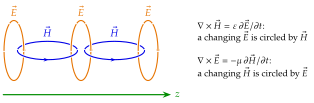
Two equations do the work. The two divergence equations of Eq. (5.5.3) are not independent of the two curl equations. Taking the divergence of the first curl equation and using gives , and in the same way the second gives . If the divergences were zero at some initial instant, for instance before the field was switched on, they stay zero for ever. This is the argument of the box "the divergence equations follow from the curl equations" of Section 5.1, specialised to a source-free region. All the dynamics therefore sits in the two curl equations, and eliminating one field between them gives a single equation for the other.