Section 5.5 · Further exercises · 1 of 10
Exercise 5.5.1: A Gaussian pulse in a dielectric
Ten further exercises in the spirit of Problems 5.5.1–5.5.6, the home exercises and the worked examples, graded from easy to harder. Exercises 5.5.1–5.5.2 are about travelling pulses, Exercises 5.5.3–5.5.5 about the wave equation itself, Exercises 5.5.6–5.5.8 about potentials and gauges, and Exercises 5.5.9–5.5.10 about retarded potentials. They use only the equations listed at the head of this subsection. All media are nonmagnetic.
A Gaussian pulse in a dielectric
#In a lossless, nonmagnetic, source-free dielectric the electric field is
(a) In which direction and with what speed does the pulse travel, and what is ? (b) Where is the peak at ? (c) How long does the field at a fixed point stay above half its peak value? (d) Find from Faraday's law.
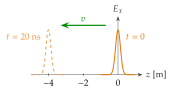
Factor the coefficient of out of the argument to read off and the direction. For use Faraday's law with the chain rule: a time derivative of is times its space derivative.
. The field is a function of with , so the pulse travels in the direction. For a nonmagnetic medium :
The peak sits where the argument is zero, .
At a fixed the field is , and for . The pulse is above half its peak over a length of (the full width at half maximum), and this length passes a fixed point in
Write . Then and Faraday's law gives . Since , this is (no static part), and :
Units: is . For a wave towards the magnetic field has the opposite sign to the one towards : points in the direction of travel.
Any shape travels without change, a Gaussian as well as a sinusoid. The duration of corresponds to a spectrum that reaches a few hundred megahertz.
cf. Problem 5.5.1