Section 5.5 · Further exercises · 2 of 10
Exercise 5.5.2: Locating a cable fault by its echo
About the further exercises of Section 5.5
Ten further exercises in the spirit of Problems 5.5.1–5.5.6, the home exercises and the worked examples, graded from easy to harder. Exercises 5.5.1–5.5.2 are about travelling pulses, Exercises 5.5.3–5.5.5 about the wave equation itself, Exercises 5.5.6–5.5.8 about potentials and gauges, and Exercises 5.5.9–5.5.10 about retarded potentials. They use only the equations listed at the head of this subsection. All media are nonmagnetic.
Locating a cable fault by its echo
#A time-domain reflectometer launches a fast step (rise time ) into a coaxial cable with solid PE insulation () and records the echo of a crushed spot after the launch. (a) How far away is the fault? (b) How long is the rising edge on the cable, and how close may two faults be and still give separate echoes? (c) The instrument, still set for solid PE, is connected to a foam-PE cable () and again sees an echo after . Where is the fault, and what distance does the instrument report? (d) The foam cable is long. How often at most may the instrument launch a step if the echo from the far end must arrive before the next launch?
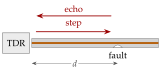
The measured time covers the way to the fault and back, , at the speed of Application 5.5.1. An edge occupies of cable.
With ,
The edge occupies of cable. Two echoes overlap if their round trips differ by less than , so two faults must be at least apart to be resolved.
In foam PE , and the fault is at . The instrument still multiplies by and reports : short, an error of .
The round trip over of foam cable takes , so at most one launch every , a repetition rate of .
The ratio of the true to the reported distance in (c), , is the ratio of the speeds, .
Every cable data sheet lists its velocity factor ( for solid PE, for foam PE, for PTFE) precisely so that the reflectometer can be set correctly. The same instrument locates breaks in buried power cables and, with optical pulses and in place of , faults in optical fibres.
cf. Worked example 5.5.1