Section 5.5 · Problems · 1 of 6
Problem 5.5.1: Velocity and direction of propagation
Velocity and direction of propagation
#Find the velocity and the direction of propagation of the phenomena denoted by the below functions:
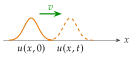
By d'Alembert, Eq. (5.5.20), a function of alone travels rigidly in the direction with speed , and a function of alone travels in the direction. So factor the coefficient of out of the argument. A function that is neither may still be a sum of such functions: try to write it as one with a trigonometric identity.
Take the coefficient of out:
a function of : speed , towards .
is a function of . It is not a sinusoid, but d'Alembert allows any twice differentiable shape: speed , towards .
The two factors alone would suggest the speeds and , and neither is the answer. Use with and :
These are two waves of the same speed , one towards with the wavelength and one towards with the wavelength .
The same identity with and :
two equal waves of speed in opposite directions: a standing wave. Nothing propagates on balance, and the zeros stay where they are.
Pick (a), (b), (c) or (d) in the menu below: (c) changes its shape because its two parts run in opposite directions at , and (d) keeps its zeros fixed.
Each function must satisfy . For (d), and , so and . For (c) the two parts have and , both giving , so the sum obeys one wave equation with . In (a) and . Figure 5.5.13 shows the four functions at three instants.
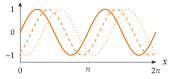
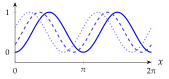
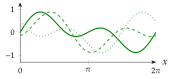
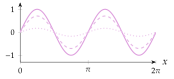
A product of a function of and a function of , as in (d), is never a single travelling wave. Snapshots tell the cases apart at a glance, which makes them a useful check on the algebra.