Section 5.5 · Problems · 2 of 6
Problem 5.5.2: Relative permittivity from the wave equation
Relative permittivity from the wave equation
#If the field
is present in a nonmagnetic, lossless and source-free medium, find the relative permittivity using the wave equation. Also write as a sum of two travelling waves, and find the magnetic field from Faraday's law.
is a Cartesian component, so it obeys the scalar wave equation Eq. (5.5.14). Each derivative of a sine or a cosine gives back the function times a constant, so the wave equation becomes one algebraic condition on . Faraday's law then gives by one integration in time (the recipe of Section 5.5.3).
depends on and only, so , as a source-free field must.
With and ,
so that
With ,
two waves of amplitude , one towards and one towards , which together form a standing wave. The frequency is and the wavelength .
For a field with only a component depending on , , and Faraday's law gives, integrating in time without a static part,
Each travelling part has with (Exercise 5.1.1), so , and the two parts add to at the maxima of . The generalised Ampère law holds too: and .
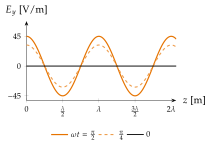
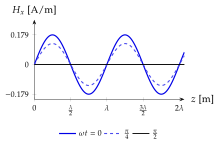
The wave equation fixes only the product , which is why the problem has to say that the medium is nonmagnetic. is a quarter period and a quarter wavelength away from (Figure 5.5.14): where has its maxima (), is zero. The energy sloshes between and inside each quarter wavelength and none is carried on average, as for any standing wave (Section 6.3).