Section 5.5 · Problems · 6 of 6
Problem 5.5.6: Retarded potential of a short current element
Retarded potential of a short current element
#A short straight wire of length on the -axis at the origin carries the current , , , in free space.
- From the retarded potential, find at a distance .
- At , find the amplitude of , the delay, and the phase lag behind the current.
- Repeat (b) at .
- At what distance is the phase lag ? What does this say about using the static formula ?
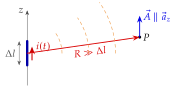
In a thin wire . Because the wire is short, the distance and the retarded time are the same for all of its points, and the integral Eq. (5.5.49) is just the length times the integrand.
, so at the amplitude is . The delay is , which is periods of the current, and the phase lag is
three full periods plus .
At the amplitude is ( times larger), the delay and the phase lag .
at
The phase lag grows linearly, per metre at : at and () at . The condition holds at both distances used. Units: is .
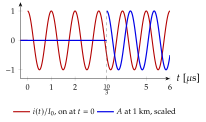
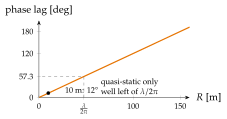
Well inside the potential follows the current almost in step, and the static formula applied at each instant is good ( phase error at , at ). Far outside it the delay is several periods and the static formula gives the wrong phase entirely. The charges that pile up at the ends of the wire add a scalar potential (Exercise 5.5.10), and together they form the Hertzian dipole, the elementary antenna. At the same lag needs : power circuits are quasi-static, radio antennas are not.