Section 5.5 · Problems · 5 of 6
Problem 5.5.5: A pair of potentials that describes nothing
A pair of potentials that describes nothing
#In free space a vector potential is given as
- Find the scalar potential that satisfies the Lorenz gauge (take the solution without a static part).
- Show that and satisfy the homogeneous wave equations.
- Find and .
- Find a scalar function with and . What does this mean?
- Repeat (c) for , .
The Lorenz gauge Eq. (5.5.41) links to , so one time integration gives . The fields then follow from Eq. (5.5.37). A pair of potentials of the form is the gauge transformation Eq. (5.5.45) of the pair .
, and the gauge gives
Both potentials are functions of alone, so they have the d'Alembert form and satisfy . Directly: and , and the same for .
depends on and only, so . The electric field has only a component:
Try :
The pair is a pure gauge transformation of . It looks like a wave, but no field exists. Note that itself satisfies the homogeneous wave equation, as the gauge function between two Lorenz pairs must.
Now , so already satisfies the Lorenz gauge, and
In (e) , and points along , the direction of travel. Faraday's law holds: .
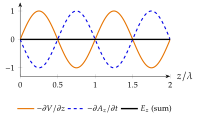
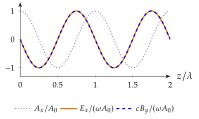
Only the part of across the direction of travel makes a field. In (e) the result is the uniform plane wave of Section 6.1, obtained here from one potential component. Exercise 5.5.8 shows that a longitudinal does produce a field when it also varies across the direction of travel, between two plates.