Section 5.5 · Problems · 4 of 6
Problem 5.5.4: Ground-penetrating radar in a lossy soil
Ground-penetrating radar in a lossy soil
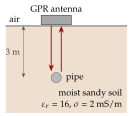
#A ground-penetrating radar sends a short pulse (centre frequency ) into moist sandy soil with , , .
- Show that the substitution with removes the first time derivative from the source-free wave equation of a conducting medium, and find the equation for .
- Find , and the attenuation constant .
- Check that the pulse is "short" in the sense of Section 5.5.7.
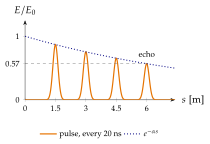
- A pipe lies deep. When does its echo arrive, and by what factor has the conduction loss reduced the amplitude on the way down and back? (Ignore the spreading of the beam and the reflection coefficient.)
The term is a friction term. Write the field as a decaying exponential in time times a new unknown, and choose the decay time so that the first derivative cancels. This turns the equation into a wave equation with a small extra term. For a short pulse the extra term is negligible, travels unchanged, and damps it.
With (dots are time derivatives),
Put these into and cancel the common factor :
With the first bracket is , and the second is :
and , so
and indeed .
At , , equivalently . Compared with , the term is smaller by . It can be dropped, , and at the pulse () , which is Eq. (5.5.33).
The path down and back is :
Read the echo on the probe at below, then choose wet clay in the menu and watch the pulse leave a wake behind it.
The ratio makes the soil a good dielectric, and the exact attenuation constant of a sinusoidal wave at (Home exercise 5.5.1) is as well. In decibels, . Units: is .
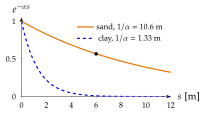
Wet clay (, ) has ten times the conductivity: , and the same path leaves of the amplitude. Ground-penetrating radar surveys work in dry sand, ice and rock, and struggle in clay and salty soil.