Section 6.3 · Topic 3 of 8
6.3.3 Standing waves and the standing-wave ratio
In medium 1 the incident and the reflected waves are present together, and they add:
Write and take the factor out of the bracket. Its modulus is , so the amplitude of the total field at the point is
The second term in the bracket is a phasor of fixed length that turns as changes. It is aligned with the when its angle is a multiple of and opposite to it when the angle is an odd multiple of . Hence the field amplitude has
- maxima where ,
- minima where ,
with an integer chosen so that the point lies in medium 1, . Since grows by when grows by , the maxima repeat every , the minima likewise, and each minimum lies from a maximum. The ratio of the largest to the smallest amplitude is the standing-wave ratio.
for no reflection, for total reflection ().
A reflected wave beats against the incident one and turns the uniform travelling wave into a rippled pattern, fixed in space, with peaks and dips half a wavelength apart. The depth of the ripples measures , their position measures the phase of .
For a real (lossless media) the pattern has a simple reading. Splitting the incident wave as ,
the total field in medium 1 is a travelling wave carrying the net power towards the interface plus a pure standing wave, which carries none. This is why the minima of a partial standing wave never reach zero.
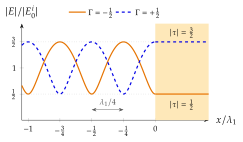
(denser medium 2): a minimum of at the interface. : a maximum. The magnetic field Eq. (6.3.18) has in place of , so the maxima of sit at the minima of and vice versa. This is how a field probe moved along a slotted line or in front of a sample measures a reflection coefficient: gives , the position of the first minimum gives (Home exercise 6.3.2).
A probe in front of a dielectric half space measures V/m and V/m, with a maximum exactly on the surface. Find .
, so . A maximum on the surface means , hence : medium 2 has three times the impedance of medium 1, .
Below, air meets (Problem 6.3.1), so and a minimum of sits on the interface. Swap the media, and , and a maximum settles there instead, with as in the quick check. Back in Problem 6.3.1, switch the layer on for a quarter-wave match.