Section 6.3 · Topic 4 of 8
6.3.4 Standing wave in front of a perfect conductor
With a perfect conductor at , , and Eq. (6.3.18) becomes
For a real the instantaneous fields follow from , with :
Each field is now a product of a function of and a function of : the pattern does not move. The electric field vanishes at all times on the planes (), the nodes of , one of which is the conductor surface. The magnetic field vanishes on the planes , halfway between them (Figure 6.3.5).
and of Eq. (6.3.23) are apart in space and in time, so
and the conductor carries the surface current ( points out of the conductor, and inside it)
A perfect mirror sends everything back. The two waves build a stationary pattern in which the energy only sloshes back and forth between electric and magnetic form inside each quarter wavelength, with no net flow. The wall current, twice the incident , is what radiates the reflected wave.
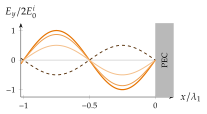
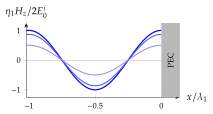
At the field is all electric, stored around the antinodes of . A quarter period later it is all magnetic, stored around the antinodes of , a quarter wavelength away. The instantaneous Poynting vector Eq. (6.3.24) carries the energy between the two, changing direction every quarter period and every quarter wavelength, and its time average is zero: a standing wave transports no power. Problem 6.3.2 puts numbers on it.
The tangential must vanish on a perfect conductor, so the wall itself is a node of and the first node in front of it is at . It is the magnetic field that has its maximum on the wall (and with it the surface current) and its first node at .