Section 6.3 · Topic 5 of 8
6.3.5 Two interfaces: the three-part problem
Coatings, windows, radome walls and layered ground all have two interfaces: a layer of medium 2, of thickness , between medium 1, from which the wave comes, and medium 3, into which it leaves (Figure 6.3.6). For this problem we use coordinates in which the layer occupies , medium 1 the region and medium 3 the region . The incident wave travels along with its electric field along . In each outer medium there is one wave per direction allowed by the physics (medium 3 extends to , so it carries only a wave leaving the layer), and inside the layer there are two, one going down () and one coming back up (), produced by the reflection at :
A wave travelling along varies as , and fixes the sign of its magnetic field by Eq. (6.3.5). The waves travelling up, along , have the opposite sign of , exactly as the reflected wave of a single interface.
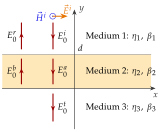
The four boundary conditions
The tangential components and are continuous on both faces. At :
and at :
These are four linear equations for the four unknowns , , and . They are solved from the far side inwards.
Step 1. The pair Eq. (6.3.29) at , added and subtracted after multiplying the second by , gives the two waves in the layer in terms of the transmitted one:
Step 2. At , form Eq. (6.3.27) Eq. (6.3.28) and Eq. (6.3.27) Eq. (6.3.28). The first combination contains only on the left, the second only :
Step 3. Insert Eq. (6.3.30). The first equation becomes with the common denominator
and the second gives in the same way. Dividing by :
For a layer of medium 2 and thickness between media 1 and 3, with the amplitudes and referred to ,
with from Eq. (6.3.31).
The layer turns the two-wave bookkeeping of one interface into a five-wave one, but the answer is still a ratio of impedance products. Everything about the layer enters through its impedance and its electrical thickness .
Checks
No layer: with and the second term of vanishes, , and
the single interface of Eq. (6.3.10). Units: is a ratio of two products of impedances. The factor in appears because and are the amplitudes referred to , a distance beyond the front face where the reflection actually happens. At the front face the incident phasor is and the reflected one , and their ratio, , is free of this factor (Section 6.3.6).
Special cases
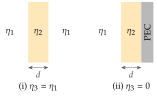
When the first and the third media are the same (, a slab in a single medium), the numerator of Eq. (6.3.32) becomes
and the denominator
Dividing both by ,
For nonmagnetic media in air, , and after multiplying through by and using this becomes the convenient form
When the third medium is a perfect conductor (),
For lossless media the numerator and the denominator of Eq. (6.3.37) are complex conjugates and have equal moduli, so : all the power comes back, and only its phase depends on .
(i) whenever , that is : a half-wave slab is invisible, whatever its permittivity. (ii) A lossless layer on a metal cannot absorb anything. With a lossy the same layer becomes an absorber: the Salisbury screen of Exercise 6.3.5 and radar-absorbing paint work this way.