Section 6.3 · Further exercises · 3 of 10
Exercise 6.3.3: Echoes of a ground-penetrating radar
About the further exercises of Section 6.3
Ten further exercises at normal incidence, in the spirit of the problems, the home exercises and the worked examples of this section, each group of five graded from easy to harder. They use only the toolbox at the head of this subsection.
Echoes of a ground-penetrating radar
#A ground-penetrating radar held just above the ground sends short pulses centred at MHz straight down. The ground is a layer of dry sand () of thickness m on top of wet clay (). Treat both as lossless and nonmagnetic, and the pulse as a plane wave at normal incidence. (a) Find the reflection coefficients of the air-sand and sand-clay interfaces. (b) What fraction of the incident power comes back from the surface, and what fraction from the buried interface (one pass down and up)? Express both in dB. (c) Find the delay between the two echoes. (d) The pulse reflected by the clay is reflected again, downwards, by the sand-air surface, and returns after a second trip. How strong is this multiple echo compared with the first, and when does it arrive? (e) For which clay permittivity would the interface be invisible?
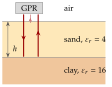
Use the single-interface coefficients with , , . A short pulse lets the echoes be separated in time, so each interface acts on its own: a field crossing an interface is multiplied by , a field turned back by . Since the returned echo travels in air like the incident wave, its power fraction is the square of its field ratio.
, . Crossing the surface downwards , upwards .
Surface echo: ( dB). Buried echo, field ratio
In sand m/s, so ns.
The multiple echo picks up the extra factor on its second round trip: field , power . It is dB weaker than the first buried echo and arrives a further ns later, ns after the surface echo.
No reflection when , that is clay with .
Power through the surface in both directions: , so the buried echo is .
Both echoes are inverted (): the radar sees "into a denser medium" twice. A layer whose echo had the opposite polarity (for example a dry void, , under the sand: ) would be recognised by the sign of the reflected pulse. Real soils are lossy, and their attenuation, not the interface reflection, usually limits the depth (compare the seawater of Problem 6.3.6 and Home exercise 6.3.3). The depth follows from the delay only if the sand permittivity is known: .
cf. Problem 6.3.3