Section 6.3 · Further exercises · 4 of 10
Exercise 6.3.4: A two-layer matching coating
About the further exercises of Section 6.3
Ten further exercises at normal incidence, in the spirit of the problems, the home exercises and the worked examples of this section, each group of five graded from easy to harder. They use only the toolbox at the head of this subsection.
A two-layer matching coating
#A thick lossless ceramic with () is to be matched to air at GHz. (a) What fraction of the power does the bare ceramic reflect? (b) Design a single quarter-wave layer. (c) Show that two quarter-wave layers, next to the air and next to the ceramic, give no reflection when , and find their thicknesses for . (d) Compare the reflectances of the two designs at GHz and the bands over which each reflects less than .
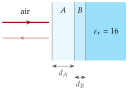
A quarter-wave layer turns the impedance behind it into . Two such layers in a row turn into . With this is . Away from use the full formula twice, with for every quarter-wave layer.
: .
, that is , and mm.
requires , . With : ( and ), and
At the impedance seen through is and through it is .
At GHz every quarter-wave layer has , . In units of : single layer , . Two layers: through , through , . Solving numerically:
At GHz each layer is a half wave and disappears: both curves return to the bare (Figure 6.3.17).
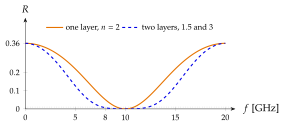
Each layer takes a smaller impedance step ( instead of ), so the partial reflections are smaller and stay nearly cancelled over a wider band. More layers with still smaller steps widen the band further. This is how broadband optical coatings and microwave lens matching layers are built.
cf. Problem 6.3.4