Section 6.3 · Further exercises · 5 of 10
Exercise 6.3.5: A resistive film in front of a metal plate
About the further exercises of Section 6.3
Ten further exercises at normal incidence, in the spirit of the problems, the home exercises and the worked examples of this section, each group of five graded from easy to harder. They use only the toolbox at the head of this subsection.
A resistive film in front of a metal plate
#A thin resistive film of sheet resistance (per square) is held mm in front of a flat metal plate (a PEC), with air between them, and a plane wave falls normally on the film. The film carries the surface current , so jumps by across it while is continuous. (a) Show that the air gap backed by the metal has, at the film, the impedance . (b) Show that the incident wave sees and in parallel, and that . (c) At which frequencies does the screen reflect nothing, and at which everything? (d) Find the band around GHz where less than of the power is reflected. (e) What is reflected at GHz if the film comes out with ? Where does the power that is not reflected go?
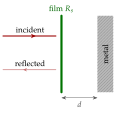
Use the transmission-line picture of Figure 6.3.2a: the gap is a line of length with , terminated by . The film adds a current to the magnetic field without changing , which is what a resistor connected across the line does.
With and the layer formula Eq. (6.3.39) gives , a pure reactance.
Let be the tangential field at the film. Behind it , and in front . The impedance seen from the front is therefore
With , and
when , : with mm at GHz. There the shorted quarter-wave gap is an open circuit and the incident wave sees only . when , : at GHz the film sits on a zero of the standing-wave and carries no current.
requires , , that is rad. Since ,
At and GHz, and ( dB).
At GHz still : , ( dB). The metal transmits nothing, so the fraction that is not reflected is dissipated as Joule heat in the film, per unit area.
Energy: for every , with equality only when the film carries no current () . At very low frequency the gap is a short circuit and , as for the bare metal.
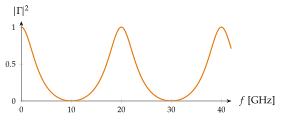
This is the oldest radar-absorbing screen (a Salisbury screen): a resistive sheet of per square a quarter wavelength in front of the surface to be hidden. It is thin and light but works over a band of only about for , and the resonances repeat at odd multiples of the design frequency (Figure 6.3.18). A metal film of conductivity and thickness has , so needs mS.
cf. Problem 6.3.2