Section 6.3 · Further exercises · 7 of 10
Exercise 6.3.7: Reading a slab from its reflection nulls
About the further exercises of Section 6.3
Ten further exercises at normal incidence, in the spirit of the problems, the home exercises and the worked examples of this section, each group of five graded from easy to harder. They use only the toolbox at the head of this subsection.
Reading a slab from its reflection nulls
#A sheet of a lossless, nonmagnetic plastic of unknown permittivity and thickness stands in air. A swept-frequency measurement at normal incidence shows that the reflected power vanishes at GHz and next at GHz, and that the largest fraction reflected between these two frequencies is . (a) Find and the thickness . (b) How many half wavelengths fit into the sheet at GHz, and at which lower frequencies is it also transparent? (c) Find the reflected fraction at GHz and at GHz. (d) Could the positions of the nulls alone have given both and ?
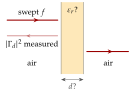
With air on both sides (Problem 6.3.3), Eq. (6.3.36) applies,
The nulls () are equally spaced in frequency. Halfway between them the sheet is an odd number of quarter waves and is largest.
The null spacing is GHz. The peak value gives the impedance step:
: four half wavelengths ( cm at GHz). The sheet is also transparent at , and GHz.
. At GHz, , :
At GHz, , : .
No. The null frequencies fix only the electrical thickness cm. A cm sheet with or a cm sheet with would have the same nulls. The depth of the pattern, set by the impedance , separates from .
At GHz the layer formula with and gives and , . At GHz the sheet is half waves: and .
This free-space method is used to measure the permittivity of radome and building materials. With losses the nulls are no longer zeros, and their depth also gives the loss tangent.
cf. Problem 6.3.5