Section 6.3 · Further exercises · 8 of 10
Exercise 6.3.8: Watching a film grow
About the further exercises of Section 6.3
Ten further exercises at normal incidence, in the spirit of the problems, the home exercises and the worked examples of this section, each group of five graded from easy to harder. They use only the toolbox at the head of this subsection.
Watching a film grow
#A film of titanium dioxide () is evaporated onto a thick glass substrate (). A monitor measures the normal-incidence reflectance at nm while the film grows. Both materials are lossless. (a) What is the reflectance before the deposition starts? (b) Show that the reflectance first rises, and find its first maximum and the film thickness at which it occurs. (c) Find the reflectance when the film is nm thick. (d) The operator stops at the third turning point of the reflectance. How thick is the film? (e) How would the record differ if silica () were evaporated instead?
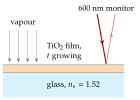
Air, film and glass are the three media of the three-part problem with . The electrical thickness of the film is . The reflectance has turning points whenever the film is a whole number of quarter waves: odd quarters transform the substrate to , even quarters make the film disappear.
.
At nm the film is a quarter wave and the surface looks like a medium of index
Since , the reflectance rises from to this maximum and falls back to at the half-wave thickness nm.
nm is an eighth wave: , . In units of , and :
The turning points lie at : (max), (min), nm (max). The film is nm thick, a three-quarter-wave layer with .
With the quarter-wave surface has , , : the reflectance first falls, to a minimum at nm.
At nm the layer formula with gives and . The curves of Figure 6.3.19, computed from the full layer formula, pass through all the values found.
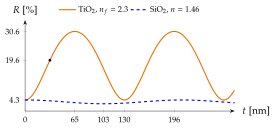
A film of higher index than the substrate always raises the reflectance, one of lower index lowers it. Counting turning points is how quarter-wave layers are cut accurately during deposition, without knowing the deposition rate. High-reflection mirrors and beam splitters are built from such quarter-wave TiO layers alternating with low-index ones.
cf. Problem 6.3.4