Section 6.3 · Problems · 1 of 7
Problem 6.3.1: Normal incidence on a dielectric
Normal incidence on a dielectric
#A uniform plane wave of frequency MHz travels in air () along with
and impinges normally on a lossless nonmagnetic dielectric with that fills .
- Find , , , and .
- Find , and the reflected and transmitted and .
- Find the standing-wave ratio in air and the positions of the maxima and minima of .
- Find the time-average power densities of the three waves and check the power balance.
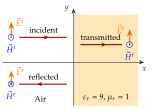
Both media are lossless, so and are real. Find the two intrinsic impedances, then and from Eq. (6.3.10). The reflected magnetic field carries the extra minus sign of a wave travelling along . The standing-wave pattern follows from , the power from Eq. (6.3.13).
With rad/s,
and . The incident magnetic field has the amplitude mA/m, and
With the reflected magnetic field points along .
. In air (). It is smallest, V/m, where , that is at , and largest, V/m, a quarter wavelength further:
With ,
At : : V/m and : mA/m . Power: W/m , and . The transmitted electric field is smaller than the incident one, V/m, but the transmitted magnetic field is larger, mA/m: medium 2 has the lower impedance.
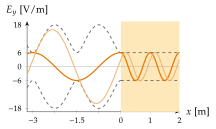
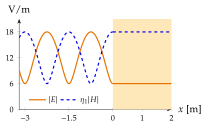
Figure 6.3.9 shows the pattern. The envelope in air oscillates between and V/m with period m, and the time snapshots stay inside it. In the dielectric the snapshots run between V/m with the wavelength m.