Section 6.3 · Problems · 2 of 7
Problem 6.3.2: Standing wave in front of a conducting wall
Standing wave in front of a conducting wall
#A uniform plane wave of frequency GHz travels in air along , A/m, and is incident normally on a perfectly conducting wall at .
- Find , and .
- Find the reflected fields and the total fields , in air.
- Within cm of the wall, where are and zero at all times?
- Find the surface current density on the wall.
- Find the time-average and instantaneous Poynting vectors.
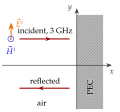
A perfect conductor has , so and . Write the incident from , add the reflected wave, and convert the sum into a product of a function of and a function of : a pure standing wave, as in Eq. (6.3.23). The wall current follows from the jump of , the Poynting vectors from the product of the total fields.
rad/m and cm. For a plane wave , with the direction of travel (the inverse of Eq. (6.3.5)): , so
With : V/m and A/m. Adding,
and with rad/s and :
where : cm. where : cm.
The normal pointing out of the conductor is , and inside the PEC :
, but the instantaneous Poynting vector is not zero:
at the wall, as a PEC requires. A/m , the jump of from its wall value to zero inside the metal, in agreement with Eq. (6.3.25). The amplitude W/m is , as in Eq. (6.3.24).
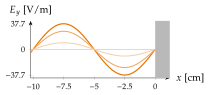
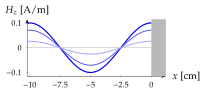
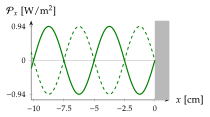
and are apart in space and in time. The instantaneous energy flow swings back and forth inside each cm cell, between an antinode and an antinode, twice per period, and the net flow is zero: everything that comes in goes back out (Figure 6.3.10).