Section 6.3 · Problems · 3 of 7
Problem 6.3.3: A dielectric slab in air
A dielectric slab in air
#A lossless nonmagnetic dielectric slab with and thickness cm stands in air. A uniform plane wave of frequency GHz is incident normally on it (the three-part problem with media 1 and 3 both air).
- Find the reflection coefficient at the front face of the slab and the fractions of the incident power that are reflected and transmitted.
- Find the standing-wave ratio in front of the slab.
- For which thicknesses is the slab transparent at GHz, and at which frequencies up to GHz is the cm slab transparent?
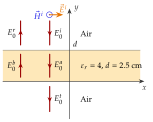
Seen from the front face, the slab followed by air is a line of length terminated by , with the input impedance Eq. (6.3.39). Everything depends on the electrical thickness , so compute it first. The special-case formula Eq. (6.3.34) serves as a second route.
rad/m ( cm) and rad/m ( cm), so
The layer is a quarter-wave transformer. With ,
The slab is lossless and the air behind it has the impedance of the air in front, so and , that is .
.
requires , which for happens when , , . At GHz: cm. For cm,
Read and below, then move to , where the slab disappears.
The special-case formula Eq. (6.3.34) with , (in units of ) and gives
referred to . Moved to the front face with Eq. (6.3.38), . The transmission coefficient Eq. (6.3.33), with , has .
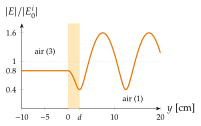
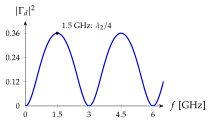
The reflected power is periodic in frequency with period GHz: zero at multiples of GHz (half-wave thickness), maximum, , at GHz (odd quarter-wave thickness), Figure 6.3.11b. A quarter-wave slab is the worst choice for a window, the reason radome walls are cut to .