Section 6.3 · Problems · 4 of 7
Problem 6.3.4: Quarter-wave transformer
Quarter-wave transformer
#A transparent dielectric coating is applied to glass (, ) to eliminate the reflection of red light μm for normally incident light.
- Determine the required relative permittivity and thickness of the coating.
- If violet light μm is shone normally on the coated glass, what percentage of the incident power is reflected?
Source: D. K. Cheng, Field and Wave Electromagnetics, 2nd ed., Problem P.8-30.
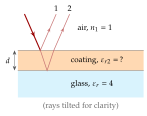
Air, coating and glass are the three media of the three-part problem, with . Dividing the numerator and the denominator of from Eq. (6.3.39) by gives a form that shows the quarter-wave limit at a glance,
Design at μm with a quarter-wave layer, then keep the thickness and evaluate the same formula at μm.
For , and :
so . With Hz,
The layer stays nm thick, so at μm
In units of , and :
Without the coating the glass reflects .
Two echoes: the air-coating and coating-glass faces reflect equally, and . At nm the round trip makes them cancel. At nm it is , so they nearly add, and is close to , as found (Figure 6.3.12b).
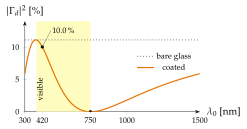
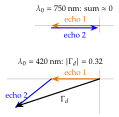
One quarter-wave layer is a narrow-band fix: it works perfectly at the design wavelength and at its odd fractions ( nm, …), while at the violet end of the visible band ( nm) the coated glass already reflects , as much as bare glass. Broadband optics use two or more layers. The ideal index for this glass is also hard to find in a durable material, which is why MgF () is the classic choice.