Section 6.3 · Problems · 5 of 7
Problem 6.3.5: Half-wave matching plate
Half-wave matching plate
#Find the minimum thickness of a fibreglass (, , ) radome for an antenna on an airplane (the antenna needs to be protected from weather) such that (1) the radome appears transparent to the antenna radiation at GHz and (2) the mechanical requirement that the radome be at least cm thick is met. Assume that the electromagnetic waves radiated (or received) by the antenna are normally incident and planar at the radome surface.
(b) Over which band around GHz does this radome reflect less than of the power? Compare with the thinnest transparent radome.
Adapted from: B. M. Notaroš, Electromagnetics, Example 10.29.
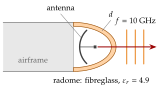
Air is on both sides of the wall, and . Referred to the front face, of the previous problem simplifies to
which vanishes when , that is for , whatever the impedance step. Pick the smallest half-wave multiple above cm, then follow with frequency.
In the fibreglass
The transparent thicknesses are cm for . The smallest one above cm is .
With , is Eq. (6.3.36),
gives
, so rad and
At GHz the formula gives for the thick wall () and for the thin one (). Midway between windows the wall is an odd number of quarter waves, and , the largest possible reflection, , which is also what the formula gives for .
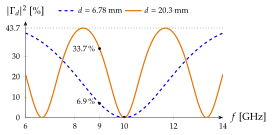
The thick wall is three half waves thick: its phase runs three times faster with frequency, so its window is three times narrower (Figure 6.3.13). At GHz it already reflects a third of the power. Real radomes reconcile strength and bandwidth with sandwich walls, two thin skins on a low-permittivity foam core.