Section 6.3 · Problems · 6 of 7
Problem 6.3.6: Aircraft-to-submarine radio communication
Aircraft-to-submarine radio communication
#A -kHz VLF aircraft antenna transmits a wave that approaches the ocean surface at normal incidence in the form of a uniform plane wave with an rms electric field intensity of kV/m. Find the maximum depth below the surface to which successful communication with a submarine is possible, if the receiving antenna on the submarine requires a minimum rms electric field intensity of nV/m, the aircraft and submarine are approximately on the same vertical line, and the parameters of seawater are and S/m.
Adapted from: B. M. Notaroš, Electromagnetics, Problem 10.14.
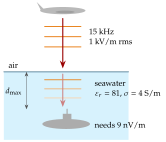
First decide what seawater is at kHz, from its loss tangent. Then the surface multiplies the field by and every metre of water by :
with the depth below the surface. Both field values are rms, so their ratio, and the depth, are the same as for peak values.
a good conductor, so
practically since .
V/m:
In decibels (re V/m): the incident field is dB, just below the surface V/m dB, the threshold dB, and the water takes dB/m: m . The exact (with kept) differs from the good-conductor value only in the sixth digit.
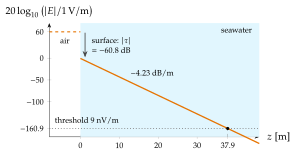
Seawater is nearly a short circuit: , and only of the incident power enters. Of the dB between the incident field and the threshold, the surface takes dB and the water the rest, dB per metre or dB per skin depth (Figure 6.3.14). A dB stronger transmitter buys only m of depth. A lower frequency buys much more, since (Home exercise 6.3.3).