Section 6.3 · Problems · 7 of 7
Problem 6.3.7: A mobile-phone wave on body tissue
A mobile-phone wave on body tissue
#A mobile-phone signal ( GHz), a uniform plane wave of amplitude V/m in air, falls normally on the flat surface of thick muscle tissue (, S/m, ).
- Find , , and of the tissue.
- Find , , the standing-wave ratio in air and the minimum nearest to the surface.
- Find the fractions of the power reflected and absorbed.
- Find the absorbed power per unit volume at the surface and the depth where it falls to .
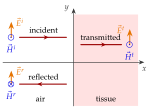
Work with the complex permittivity , so that and with (Section 6.2). The loss tangent decides which approximation is allowed. Here none is, and the complex square root must be taken exactly. The air side is a partial standing wave, the tissue side a decaying wave whose power is turned into heat.
S/m, so and
since . is neither (good dielectric) nor (good conductor). Then
and with rad/m, :
With :
In air . Its maxima, V/m, lie where :
The minima, V/m, lie cm from the maxima, where The solution with , mm, lies just inside the tissue, where the air expression does not hold. The nearest minimum in air is therefore at
and between cm and the surface falls monotonically to V/m, only above the minimum value: practically a minimum on the surface.
and the rest, , enters the tissue and is absorbed there. In watts: W/m, of which W/m enters.
Just inside, V/m, and the Joule loss per unit volume is
a specific absorption rate W/kg for kg/m. The field decays as , so , and at .
From the transmitted wave, Eq. (6.3.17): , so . All the power that enters is turned into heat: W/m .
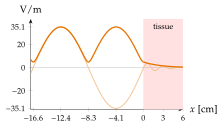
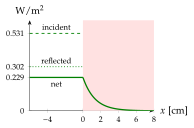
Tissue at GHz behaves like a poor conductor: has a near-zero right at the surface ( V/m against V/m at the maxima, Figure 6.3.15a), and everything that enters is absorbed within a few centimetres. Exposure limits are written as SAR, for example W/kg averaged over g of head tissue for a phone held to the ear (EU). A distant V/m plane wave gives less than of that.