Section 6.3 · Worked examples · 1 of 2
Worked example 6.3.1: Antireflection coating of a silicon solar cell
Two short calculations tied to Application 6.3.1. They use only the normal-incidence , the input impedance of a layer and the coefficients of this section, and no new physics. Material losses are neglected, and m/s. For nonmagnetic media all impedances are written as . A good way to use them: read the given quantities, pick the formula yourself, and only then put the numbers in.
Antireflection coating of a silicon solar cell
#cf. Application 6.3.1
Given. Crystalline silicon, at nm (absorption neglected at the surface). Coating: silicon nitride, , deposited for a quarter wave at nm. Normal incidence from air.
Find. (a) the reflectance of bare silicon, (b) the ideal coating index and the nitride thickness, (c) the reflectance of the coated cell at nm, (d) at and nm (dispersion neglected), (e) how much more light enters the cell at nm.
A quarter-wave layer turns the silicon impedance into , that is , and . Away from the design wavelength the layer is not a quarter wave any more and the full formula Eq. (6.3.39) is needed, with .
: of the light is lost.
Zero reflection needs , and nitride () is close. The thickness is a quarter of the wavelength in the layer:
, so
At nm (), at nm (). In units of , , , and
The transmitted fraction rises from to , a factor .
As moves from towards (long wavelengths) or towards (a half wave, nm), grows steadily from to the bare , where the layer disappears. Both values in (d) lie in between (Figure 6.3.21).
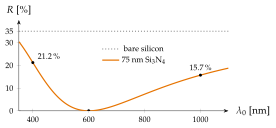
One nm layer recovers half again as much light at mid-spectrum. The residual reflection rises towards the violet, which is why coated cells look dark blue. Real cells add surface texturing to cover the whole to nm band.