Section 6.3 · Worked examples · 2 of 2
Worked example 6.3.2: Wi-Fi through a window pane
About the worked examples of Section 6.3
Two short calculations tied to Application 6.3.1. They use only the normal-incidence , the input impedance of a layer and the coefficients of this section, and no new physics. Material losses are neglected, and m/s. For nonmagnetic media all impedances are written as . A good way to use them: read the given quantities, pick the formula yourself, and only then put the numbers in.
Wi-Fi through a window pane
#cf. Application 6.3.1
Given. A single pane of soda-lime glass, , , thickness mm, losses neglected, air on both sides. A Wi-Fi signal arrives at normal incidence.
Find. (a) the wavelengths in air and glass and the electrical thickness at GHz, (b) , the reflected power and the transmission loss in dB, (c) the same at GHz, (d) the pane thickness that would be transparent at GHz, and the worst thickness.
This is the three-part problem with media 1 and 3 equal, Eq. (6.3.35):
Since the pane is lossless, and the transmission loss is .
. In units of , and ().
mm and mm, so
, :
so is reflected, transmitted, and the loss is dB.
At GHz: mm, mm, rad , , , reflected, loss dB.
No reflection for , mm. Worst for , mm, where and , ( dB).
No thickness can reflect more than the quarter-wave value , and both answers stay below it (Figure 6.3.22).
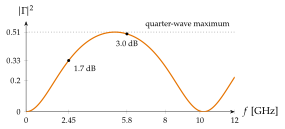
An ordinary pane is electrically a fraction of a wavelength thick and costs to dB, more at GHz than at GHz, and real glass adds a little absorption. Energy-saving (low-E) glazing carries a thin metal-oxide film that behaves like a conductor and can add dB or more, a real problem for indoor mobile coverage (Exercise 6.3.9).