Section 6.4 · Topic 1 of 13
6.4.1 The plane of incidence and the two polarisations
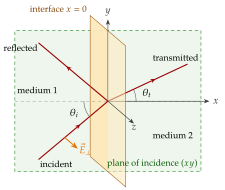
Let the interface be the plane , with medium 1 (, ) in and medium 2 (, ) in , both lossless unless stated otherwise. The normal to the interface is . The plane of incidence is the plane that contains the incident ray (the direction of travel of the incident wave) and the normal. We choose the axes so that it is the -plane (Figure 6.4.1a). All angles are measured from the normal: the angle of incidence , the angle of reflection and the angle of transmission, or refraction, .
A uniform plane wave travelling in the direction of the unit vector has the phasor
with , and . This is the wave of Section 6.1 with the -axis turned into the direction : the phase is constant on the planes const, and lie in those planes, and is a right-handed triad. The vector is called the wave vector. For the incident wave in Figure 6.4.1
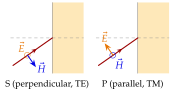
The incident field must be perpendicular to , but it may point in any direction in the plane normal to the ray. Every such field is the sum of two components, and these two cases are treated separately.
Perpendicular (S) polarisation: is perpendicular to the plane of incidence, , and lies in the plane of incidence. It is also called transverse electric (TE), because has no component along the normal , and horizontal polarisation in radio work, where the interface is the ground. The letter S comes from the German senkrecht, perpendicular.
Parallel (P) polarisation: lies in the plane of incidence and is perpendicular to it, . It is also called transverse magnetic (TM) and, over the ground, vertical polarisation.
Why may the two cases be treated separately? At the interface the tangential components are , , and . An S wave carries only and (and the normal ), a P wave only and (and the normal ). The four boundary conditions therefore split into two independent pairs: and couple the S waves among themselves, and the P waves. An S wave can only produce S waves, a P wave only P waves, and an arbitrary incident wave is handled by splitting it into its S and P parts, solving each case, and adding the results.