Section 6.4 · Topic 2 of 13
6.4.2 Perpendicular (S) polarisation: the three waves
Let the incident wave be S-polarised. With Eq. (6.4.1) and Eq. (6.4.2) the incident field is
The magnetic field follows from with
The reflected wave travels back into medium 1 at an angle which we do not yet know. Its direction is : the -component is reversed, the wave keeps moving up the interface. With ,
The transmitted wave repeats the incident one with the constants of medium 2 and the angle :
Figure 6.4.2 shows the reference directions. At normal incidence these three waves reduce to those of Section 6.3, with along instead of .
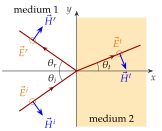
Compared with normal incidence the problem has more unknowns. Besides the amplitudes and we do not know the angles and . Two boundary conditions cannot fix four numbers, unless they hold in a stronger sense than before. They do: the conditions must be satisfied not at one point but at every point of the interface, and this is what fixes the angles.