Section 6.4 · Topic 3 of 13
6.4.3 The boundary conditions and Snell's law
There are no surface currents on the interface between two dielectrics, so the tangential components of and of are continuous at . For the S waves the tangential components are and :
Inserting the waves Eq. (6.4.3) to Eq. (6.4.5) at gives
Each equation is a sum of three exponentials in . If their exponents were different, the three terms would oscillate along the interface at different rates and could cancel at a few isolated points at best, never at every . The equations can hold for all only if the three exponents are equal:
This is called phase matching: the three waves must have the same phase variation along the interface.
Suppose for all , with nonzero , , . Multiply by : . The right-hand side is constant, so the derivative of the left-hand side vanishes for all : . If , the two exponentials are linearly independent (their ratio is not constant), so and , that is , a contradiction. Hence , and then requires as well. With , and this is Eq. (6.4.9). The only escape, and , would mean no transmitted wave, which the second equation Eq. (6.4.8) then forbids unless the amplitudes all vanish.
With the refractive index , so that , Snell's law reads
and for nonmagnetic media . Both laws hold for any polarisation.
The angle of reflection equals the angle of incidence. A wave that enters a denser medium () is bent towards the normal, a wave that enters a less dense medium is bent away from it. Both statements follow from one requirement: the crests of all three waves must meet along the interface with the same spacing.
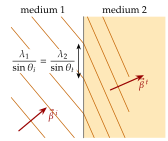
Figure 6.4.3 shows phase matching. Successive crests of the incident wave are a wavelength apart along its ray, and they cut the interface at points spaced apart. The crests of the transmitted wave must start from the same points, so their spacing along the interface, , is the same. Since , this is exactly Eq. (6.4.10). The spacing is called the trace wavelength of the wave on the interface. It is always longer than both and .
Light in air meets a calm water surface () at from the normal. At which angle does it travel in the water, and at which angle does the reflected light leave?
, so : the light is bent towards the normal. The reflected light leaves at on the other side of the normal.
Snell's law uses angles measured from the normal. With angles measured from the interface (the grazing angle of radio engineers, or the angle between a ray and the axis of an optical fibre), the sines become cosines. Problem 6.4.3 and Exercise 6.4.6 use both angles: convert first, then apply the formulas.