Section 6.4 · Topic 4 of 13
6.4.4 The Fresnel coefficients for S polarisation
With and the three exponentials in Eq. (6.4.7) and Eq. (6.4.8) are the same function of and cancel. What is left is
Define, as for normal incidence, the reflection and transmission coefficients and . Dividing by , and the second equation also by ,
Adding the two equations eliminates : , which gives , and then .
with from Snell's law Eq. (6.4.10), and .
The formulas are those of normal incidence, , with each impedance divided by the cosine of the angle in its own medium: the S wave sees the impedances and . Dividing numerator and denominator of Eq. (6.4.13) by shows this at once.
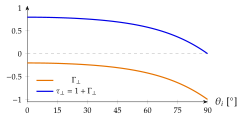
Three limits check the result. At normal incidence, , both coefficients reduce to those of Section 6.3. If medium 2 is a perfect conductor, and , at every angle: the tangential , which is the whole of for an S wave, vanishes on the conductor. At grazing incidence, , the term vanishes and for any pair of media. Figure 6.4.4 shows the coefficients for light going from air into glass: starts at and grows steadily in magnitude, at , at , to at grazing incidence. Every surface becomes a mirror for S waves at grazing angles, as anyone who has looked along a window pane or a lake knows.