Section 6.4 · Topic 10 of 13
6.4.10 Both polarisations at a glance
Table 6.4.1 collects the results. The two polarisations share the law of reflection, Snell's law and the critical angle, and differ in their coefficients and their Brewster angles.
Table 6.4.1. Oblique incidence on the plane interface between two lossless media.
| S polarisation | P polarisation | |
|---|---|---|
| Brewster angle | ||
| nonmagnetic media | no Brewster angle | , |
Common to both: , , when , , , .
Below, a wave in air meets at (Problem 6.4.1). Switch to P and drag the ray away from and back: at the reflected ray vanishes and .
|Γ| against the angle of incidence
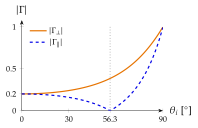
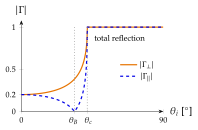
Figure 6.4.13 shows the magnitudes of both coefficients for glass, seen from either side. From air (left), both start at . grows steadily to , falls to zero at and then rises steeply to . At every angle . From the glass side (right) the Brewster angle is , and beyond both magnitudes are . The Brewster angle always comes before the critical angle, because .
Polarisation filters
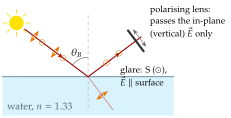
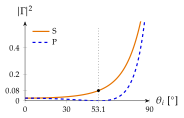
We may note that is usually greater than . The light reflected towards the eye from water, a road or a window is therefore predominantly perpendicularly polarised, and its electric field is parallel to the reflecting surface, horizontal for water and roads. At the Brewster angle of water, , the glare is purely S-polarised and carries of the S half of the sunlight (Figure 6.4.14). Filters that block the S component, such as polarising sunglasses or a photographer's polarising filter with its transmission axis vertical, remove the reflection: the stones under the water and the curtains behind a window pane appear.
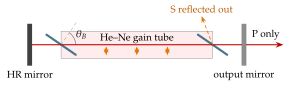
Gas lasers. The gain of a helium-neon laser is only a few per cent per pass, so every loss between the mirrors counts. The gain tube is closed by plates of fused silica () tilted so that the beam meets them at the Brewster angle (Figure 6.4.15).
- The P wave crosses each surface with : no loss at all. Since the faces of a window are parallel, the beam meets the inner face at , which is the Brewster angle seen from the glass, so the inner face is reflection-free too.
- The S wave loses of its power at each surface, per round trip through the eight surfaces of the two windows (Worked example 6.4.1), so it never reaches the threshold of oscillation.
The output is linearly polarised in the plane of incidence, for free.
Tilt a dielectric plate until the light meets it at and the P light passes untouched, while a fixed fraction of the S light is reflected at every surface. Repeating this at many surfaces separates the two polarisations.
Polarisers and glare.
- A pile-of-plates polariser: ten glass plates () at pass all of the P power but only of the S power, since each of the twenty surfaces reflects of it (multiple reflections neglected). Unpolarised light leaves with a degree of polarisation . Such stacks are used in high-power lasers, where a polarising film would burn.
- Sunglasses and camera filters absorb the horizontal , that is the S-polarised glare from water, roads and car bonnets (Figure 6.4.14). Exercise 6.4.3 works out how much glare a windscreen sends to a driver.
- Radio: ground with has , a pseudo-Brewster angle, because real ground is lossy and only passes through a minimum. Near grazing incidence a vertically polarised (P) wave is reflected much less than a horizontally polarised one, which shapes the coverage of low-angle radars and of broadcast transmitters (Exercise 6.4.6).
Table 6.4.2. The applications of this section.
| Application | Physics used | Worked out in |
|---|---|---|
| Prisms and optical fibres | , , | Problems 6.4.2, 6.4.3, Home exercise 6.4.1 |
| Brewster windows, polarisers | , , | Problem 6.4.1, Worked example 6.4.1 |