Section 6.4 · Topic 9 of 13
6.4.9 The Brewster angle in P polarisation
when . Squaring and using Snell's law for ,
and with and :
For media with the same permeability (all nonmagnetic media)
The last relation follows from Snell's law: at , . The Brewster angle always exists for P polarisation between two dielectrics, from either side: air to glass , glass to air .
At the Brewster angle a P-polarised wave crosses the interface without any reflection, and the reflected and the refracted ray would be at right angles to each other. An S wave is always partly reflected. Light reflected at is therefore purely S-polarised: polarisation by reflection, discovered by David Brewster in 1815.
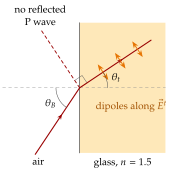
The reflected wave is not produced by the surface itself. It is radiated by the bound dipoles of medium 2, which the transmitted field sets oscillating along (Figure 6.4.12). An oscillating dipole radiates most strongly at right angles to its axis and not at all along it. At the reflected direction is exactly the axis of the P dipoles, so they cannot send anything back. The S dipoles point out of the plane of incidence and radiate equally in all directions within it, which is why an S wave has no Brewster angle in nonmagnetic media.
Sunlight is reflected by a glass window () at the Brewster angle. Which fraction of the S power is reflected?
At , and, in units of , . With and this simplifies to , so of the S power. The P power is not reflected at all.