Section 6.4 · Topic 8 of 13
6.4.8 Parallel (P) polarisation
Now let be perpendicular to the plane of incidence and lie in it (Figure 6.4.10). The incident wave travels along , and its electric field is perpendicular to that direction within the -plane:
The reference directions of the electric fields are chosen so that the magnetic fields point along and each wave obeys . For the incident wave . For the reflected wave , which explains the minus sign in . Both reference vectors of and have the same tangential component , and at normal incidence both become .
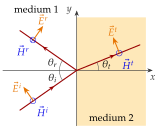
The reference direction of in P polarisation is a convention. With the choice made here, at normal incidence. Some books reverse (so that points along ), and their has the opposite sign. Both are correct with their own figures. Before taking a formula or a numerical value of from another source, check its reference directions. Exercise 6.4.5 and Exercise 6.4.6 show where the sign matters.
Boundary conditions
The tangential components at are and . Phase matching works exactly as for S polarisation, so Snell's law Eq. (6.4.10) holds and the common factor cancels. With ,
With and these read
Note that : the electric field is not entirely tangential, and only its -part, times the amplitude, has to be continuous. From the second equation . Substituting into the first, , and solving for :
with the reference directions of Figure 6.4.10. The power fractions are given by Eq. (6.4.15), and .
For P polarisation each medium presents the impedance , the ratio of the tangential to the tangential , and the formula is again the normal-incidence one written with these impedances. Multiplying the two equations Eq. (6.4.28) gives , that is .
If medium 2 is a perfect conductor, and the coefficients become and , as for S. At normal incidence . Snell's law, total reflection and the evanescent wave apply to P polarisation unchanged. Beyond , with ,
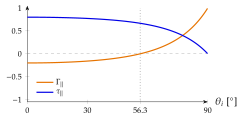
Figure 6.4.11 shows the P coefficients for air on glass. starts at , as does, but rises to zero at , changes sign and tends to at grazing incidence. The angle at which it vanishes is the subject of the next subsection.