Section 6.4 · Topic 7 of 13
6.4.7 The Brewster angle in S polarisation
Can the reflection vanish at some angle? For S polarisation Eq. (6.4.13) gives when
The angle of incidence at which this happens is called the Brewster angle, . To find it in terms of the medium parameters, eliminate with Snell's law:
Squaring and collecting the terms in ,
Finally and, since , .
For media with the same permeability, in particular for all nonmagnetic media, the denominator vanishes while the numerator does not: there is no Brewster angle for S polarisation. For media with the same permittivity but different permeabilities, .
Between two ordinary dielectrics an S wave is reflected at every angle. A reflection-free S wave needs a magnetic contrast between the media, a situation that is very rare in practice.
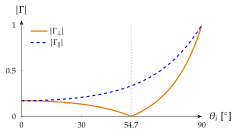
Figure 6.4.9 shows such a rare case: air on a medium with and . Then and . Here the S wave is fully transmitted at while the P wave is reflected (), the mirror image of the behaviour of ordinary dielectrics that we meet in Subsection 6.4.9.