Section 6.4 · Topic 6 of 13
6.4.6 Total reflection and the critical angle
Write Snell's law as
If the wave enters a denser medium, , the right-hand side is always smaller than one and there is a transmitted wave at every angle of incidence. If the wave goes into a less dense medium, , as light that tries to leave glass for air, the transmitted wave is bent away from the normal, and reaches at a finite angle of incidence. Beyond that angle the right-hand side of Eq. (6.4.16) exceeds one, there is no real angle , and, as we show below, the incident wave is totally reflected.
For the angle of incidence at which is the critical angle
For total reflection occurs, for both polarisations.
Light can be totally reflected only on its way out of a dense medium, and only if it meets the surface obliquely enough. Glass to air: . Water to air: . Diamond to air: .
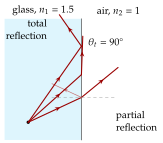
Figure 6.4.6 follows three rays from a source inside glass. At the ray leaves into the air at and a weak part is reflected. At the refracted ray grazes the surface. At nothing leaves and the whole wave is reflected.
Beyond the critical angle: the evanescent wave
What happens to the transmitted wave when ? Phase matching Eq. (6.4.9) still holds: the transmitted field must vary along the interface as , with . Its -dependence is with , so is imaginary. Of the two roots we must take
because then decays into medium 2. The other root would give a field that grows without bound away from the interface, which no source in medium 1 can produce.
For the transmitted field of an S wave is
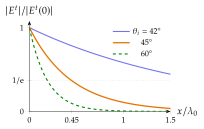
a wave that travels along the interface with the phase constant and decays exponentially away from it. Its amplitude falls to in the distance , a fraction of a wavelength except just above .
Beyond the critical angle the wave in medium 2 can no longer leave the interface. It runs along the surface, locked in phase to the incident wave, and its field dies away within a fraction of a wavelength of the surface.
The Fresnel formulas remain valid with the imaginary . Writing in Eq. (6.4.13),
Numerator and denominator are complex conjugates, so : the reflected wave carries the full incident amplitude, and total reflection only shifts its phase. The same holds for (Subsection 6.4.8). The transmitted magnetic field has , in phase quadrature with , so the normal component of the time-average Poynting vector, , is zero: no time-average power crosses the interface. The component , built from and the real , is not zero: power flows along the face, inside the thin evanescent layer, but not away from it.
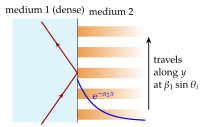
Total reflection does not mean that the field stops at the interface. The evanescent field is real and can be measured, it merely stores energy and returns it, carrying no net power away. Bring a second dense medium within a fraction of a wavelength of the face and the evanescent field becomes a travelling wave again inside it: power tunnels across the gap. This frustrated total reflection is used in beam-splitter cubes and fingerprint sensors, and it is the optical counterpart of quantum-mechanical tunnelling.
Writing gives a field that grows as , which is unphysical, and a reflection coefficient with the wrong sign of its phase. With the time factor and waves written as , the decaying root is always .
Light of free-space wavelength meets a glass-air face () from inside the glass at . Is it totally reflected, and how far into the air does the field reach?
: yes. with , so : the field falls to in about a fifth of a wavelength.
Below, light of meets a glass-air face from inside the glass (). Drag through and watch reach , after which only its phase changes and shrinks, to at .
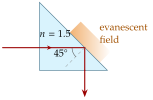
Prisms. For glass () the critical angle is , so a beam that meets the hypotenuse of a –– prism at from inside is reflected completely (Figure 6.4.8a). It is a mirror with no metal, no tarnish and no absorption, which works for any glass with . Binoculars (the Porro prisms), periscopes and retroreflectors use it. The field outside the hypotenuse is evanescent, as Problem 6.4.2 shows with numbers. A second prism brought within a fraction of a wavelength lets light tunnel across: beam-splitter cubes and fingerprint sensors rely on such frustrated total reflection.
Optical fibres. A glass core of index is surrounded by a cladding of slightly lower index . A ray that meets the core-cladding boundary at is totally reflected at every bounce and is trapped in the core over kilometres (Figure 6.4.8b). A trapped ray makes the angle with the fibre axis, at most . At the end face Snell's law turns this into the largest angle at which light can be launched from air: .
where , the acceptance angle, is the half-angle of the cone of rays that the fibre guides.
The larger the index step between core and cladding, the wider the cone of light that a fibre accepts. An index step of only already gives an acceptance angle of about (Problem 6.4.3).
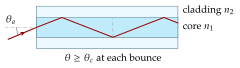
- Telecom fibre, , : , , . Guided rays are almost parallel to the axis. Problem 6.4.3 adds the delay spread between the axial and the steepest ray.
- Multimode fibre, , : , , . For a ray at at , , so the evanescent tail reaches only into the cladding.
- The evanescent tail runs in the cladding, which is therefore made many wavelengths thick: a standard fibre has a cladding around a core, and touching its outside does not disturb the light.
What is the smallest refractive index for which a prism reflects totally in air?
Total reflection at needs , , so . Every ordinary optical glass qualifies.