Section 6.4 · Further exercises · 3 of 10
Exercise 6.4.3: Glare from a windscreen
About the further exercises of Section 6.4
Ten further exercises in the spirit of Problems 6.4.1–6.4.6 and the home exercises, in two groups each graded from easy to harder: Exercises 6.4.1–6.4.5 on the coefficients, the critical angle and the Brewster angle, Exercises 6.4.6–6.4.10 on applications in radio, fibre optics, microscopy, radomes and metal walls. They use only the equations listed at the head of this subsection and, where stated, the normal-incidence results of Section 6.3.
Glare from a windscreen
#Unpolarised sunlight (equal S and P power, uncorrelated) is reflected by a car windscreen () towards a driver, at an angle of incidence of . Consider only the front surface. (a) Find , and . (b) Find the reflectance for each polarisation and for the unpolarised light. (c) Find the degree of polarisation of the glare. (d) Polarised sunglasses block the S component. What fraction of the glare still reaches the eye, in dB? (e) At what angle would the glasses remove the glare completely?
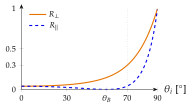
For uncorrelated S and P halves the reflected powers add: . A filter that blocks S leaves of the glare.
, , , . With , :
, , and for sunlight : four times the of normal incidence.
: the glare is polarised, with mostly parallel to the glass (S).
: the glasses cut the glare to , by .
At the Brewster angle the reflected light is pure S and is blocked completely.
The angle forms of Home exercise 6.4.2 give and . is negative at normal incidence (), passes through zero at and is positive beyond it.
The glare from water, roads and car bonnets is strongly S-polarised over a wide range of angles around , not only at itself, which is why polarised sunglasses work so well. Above about grows quickly and the protection drops (at , ).
cf. Problem 6.4.1