Section 6.4 · Further exercises · 2 of 10
Exercise 6.4.2: Light trapped in an LED chip
About the further exercises of Section 6.4
Ten further exercises in the spirit of Problems 6.4.1–6.4.6 and the home exercises, in two groups each graded from easy to harder: Exercises 6.4.1–6.4.5 on the coefficients, the critical angle and the Brewster angle, Exercises 6.4.6–6.4.10 on applications in radio, fibre optics, microscopy, radomes and metal walls. They use only the equations listed at the head of this subsection and, where stated, the normal-incidence results of Section 6.3.
Light trapped in an LED chip
#Light is generated inside the semiconductor of a light-emitting diode (, nonmagnetic) and has to leave through its flat top face into air. (a) Find the critical angle. (b) The light is emitted equally in all directions. What fraction falls inside the cone that can leave through the top face? (c) What fraction of the light inside that cone is transmitted at normal incidence? (d) For a ray meeting the face at find , , , , and the transmitted power fractions, and check them against . Comment on .
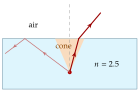
Medium 1 is the semiconductor (), medium 2 the air. Rays beyond are totally reflected back into the chip. The cone of half-angle subtends the solid angle out of the full .
.
: only of the emitted light can leave through the top.
: is transmitted at normal incidence.
, , , . With , :
With : and , and indeed , .
is no paradox: the field in air is larger because , and the beam in air is narrower by the factor in the power balance. Averaged over the cone (unpolarised light) about of the light in it escapes, that is about of everything emitted.
This is the central problem of LED design: a flat chip lets out only a few per cent of its light per face. Manufacturers roughen the surface (so trapped rays get new angles at every bounce), shape the chip, and embed it in an epoxy or silicone dome of index , which raises to and the cone fraction to , while the curved dome surface meets the light nearly at normal incidence.
cf. Problem 6.4.2