Section 6.4 · Further exercises · 1 of 10
Exercise 6.4.1: Reading an oblique wave from its phasor
Ten further exercises in the spirit of Problems 6.4.1–6.4.6 and the home exercises, in two groups each graded from easy to harder: Exercises 6.4.1–6.4.5 on the coefficients, the critical angle and the Brewster angle, Exercises 6.4.6–6.4.10 on applications in radio, fibre optics, microscopy, radomes and metal walls. They use only the equations listed at the head of this subsection and, where stated, the normal-incidence results of Section 6.3.
Reading an oblique wave from its phasor
#In air () the incident wave is . The region is a lossless nonmagnetic dielectric with . (a) Find the frequency, the wavelength in air and the angle of incidence. Which polarisation is this? (b) Find the angle of refraction and the transmitted wave vector, and show that the wavelength measured along the interface is the same on both sides. (c) Find , and the phasors , and . (d) Check the power balance.
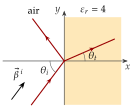
Compare with : the coefficients of and are the components of . along is normal to the plane of incidence (the -plane): S polarisation. Phase matching keeps on both sides.
, so and . : (, ). Perpendicular (S) polarisation.
. , , , and
Along the interface both waves vary as : the trace wavelength is on both sides, longer than and , since .
In units of , , :
, , and .
Tangential at : incident , reflected , sum .
The trace wavelength along the interface, , is what any antenna array lying in the interface would see: it is how the angle of arrival of a wave is measured from the phase difference between two elements.
cf. Problem 6.4.1