Section 6.4 · Home exercises · 4 of 4
Home exercise 6.4.4: Parallel polarisation on a perfect conductor
Parallel polarisation on a perfect conductor
#In the geometry of Problem 6.4.4 (perfect conductor at , air in ) the incident wave now has the magnetic field .
- Find and state the polarisation.
- Find the reflected fields and the total fields in air.
- Find the surface charge and current densities, and check .
- Where could a second conducting plane be placed without disturbing the field?
Adapted from: D. K. Cheng, Field and Wave Electromagnetics, 2nd ed., Problem P.8-23.
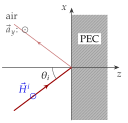
The direction is that of Problem 6.4.4, , , . Now is normal to the plane of incidence: P polarisation. Get from , choose the reflected wave so that the tangential vanishes on the wall, and read the surface sources from the boundary conditions and with .
parallel (P) polarisation, .
The reflected wave travels along . cancels the incident , and fixes its -component:
Adding,
At : and , so
Continuity:
the same.
vanishes on the planes , and everywhere, so a conducting plane there meets only a normal and a tangential , as a perfect conductor requires.
With the reference directions of Figure 6.4.10, and for : the tangential parts of and cancel and the normal parts add, . Also : the full tangential doubles at the wall, at any angle.
Unlike the S wave of Problem 6.4.4, the P wave has an normal to the wall, so it carries surface charge, and that charge travels along with the current. Between the wall and a second plate at this field is a TM mode of the parallel-plate waveguide, while the field of Problem 6.4.4 is a TE mode (Section 7.2).