Section 6.4 · Home exercises · 3 of 4
Home exercise 6.4.3: How a rain sensor sees water
How a rain sensor sees water
#A rain sensor sends infrared light through a windscreen () so that it meets the outer surface at and returns to a detector.
- Show that the light is totally reflected when the glass is dry.
- With a water film () on the glass, find the critical angle, the angle of refraction, and the fractions of S- and P-polarised power that leak into the water.
- Find the Brewster angle of the glass-water interface, seen from the glass.
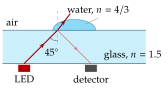
Medium 1 is now the glass, . Compare with the critical angle of the glass-air and of the glass-water interface. When no total reflection occurs, the Fresnel formulas give the reflected fraction, and everything that is not reflected leaves the glass and is lost to the detector.
Glass to air: . The ray is totally reflected, for both polarisations, and all the light returns to the detector.
Glass to water: , , so there is no total reflection. Snell's law gives
With , and :
The fractions that leak into the water are (S) and (P).
: , close to , which is why P leaks almost completely.
.
A raindrop thus switches the reflection from to about at the spot where it sits, and the detector signal drops by the fraction of the sensing area that is wet. The sensor therefore measures the wet area, from which the wiper controller sets the wiping speed.