Section 6.4 · Home exercises · 2 of 4
Home exercise 6.4.2: The Fresnel formulas
The Fresnel formulas
#For two nonmagnetic dielectrics, use to show that the coefficients of this section can be written with angles only:
Then deduce from that the Brewster angle satisfies , and from that no such angle exists for S polarisation.
Adapted from: D. K. Cheng, Field and Wave Electromagnetics, 2nd ed., Problem P.8-42.
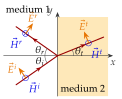
Multiply the numerator and the denominator of each coefficient by , so that becomes . Then use the addition formulas and the sum-to-product identities.
and in the same way .
For and , and the numerator is not zero. can vanish only through :
For S the denominator is finite, and would need , that is , which by Snell's law means : no interface at all.
Problem 6.4.1 (, ): , , . At normal incidence, with , both 's tend to .
With the reflected direction is parallel to , which is the dipole picture of Figure 6.4.12: the bound dipoles of medium 2 do not radiate along their own axis. The angle forms also show at a glance that , since .