Section 6.4 · Home exercises · 1 of 4
Home exercise 6.4.1: Why a diamond sparkles
Why a diamond sparkles
#Diamond is a nonmagnetic dielectric with refractive index in the visible.
- Find the critical angle for light inside the diamond trying to leave into air.
- Find the Brewster angle for light going from air into diamond, and from diamond into air. Verify that the two add up to .
- Find the reflectance of a diamond surface at normal incidence.
- Use (a) to explain why light entering the top of a well-cut stone leaves again through the top.
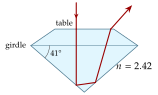
All three angles follow from the nonmagnetic forms , and . For (d) follow one ray through the stone and compare its angles of incidence with .
.
Air to diamond: . Diamond to air: . Since , the two angles are complementary: . They are also the two angles , of one and the same ray, crossed in opposite directions.
.
Any internal ray meeting a facet at more than is totally reflected. In a brilliant cut the lower (pavilion) facets make about with the plane of the girdle. A ray entering the top (table) at normal incidence meets the first pavilion facet at and, after reflection, the opposite facet at : both beyond , both total. It then travels upwards at to the vertical, below , and leaves through the top.
, as it must be for any pair of media (Subsection 6.4.10: ). The ray in the figure is drawn to scale: it leaves the table at inside the stone and, by Snell's law, at in the air.
The small critical angle is what makes diamond special: glass () cut in the same shape would leak most of the light through the pavilion. The large index also gives a strong surface reflection (, four times that of glass) and, through its variation with wavelength, the coloured “fire”.