Section 6.4 · Problems · 6 of 6
Problem 6.4.6: Circular polarisation at the Brewster angle
Circular polarisation at the Brewster angle
#A circularly polarised light beam in air strikes a calm water surface at the Brewster angle. At optical frequencies water is a lossless dielectric with (). Each of the two orthogonal components of the incident has the amplitude .
- Find and the angle of refraction.
- Find , , and .
- Describe the polarisation of the reflected and transmitted waves.
- What fraction of the incident power is reflected? Compare with normal incidence.
Adapted from: B. M. Notaroš, Electromagnetics, Example 10.25.
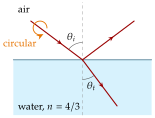
A circularly polarised wave is an S part and a P part of equal amplitude , out of phase. The interface treats the two parts separately with their own Fresnel coefficients, and the reflected and transmitted parts are recombined afterwards. Each part carries half of the incident power, so .
: (, ), and . Snell checks: .
Divide the numerators and denominators by , with and :
Reflected: only the S part survives, with amplitude . The reflected light is linearly polarised, with parallel to the water surface. Transmitted: the P part and the S part , still apart in time: elliptically polarised, with the axial ratio , almost circular, and the same sense of rotation.
. At normal incidence for both parts, , and the reflected wave is circular with the opposite handedness (it travels the other way).
and .
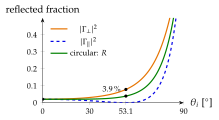
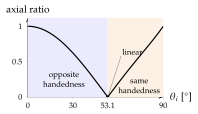
Only at is the reflection purely S: polarisation by reflection. This is why glare from water is horizontally polarised and why polarising sunglasses, with a vertical transmission axis, remove it. Below the reflection is elliptical with the opposite sense of rotation, above with the same sense, because changes sign at .