Section 6.4 · Problems · 5 of 6
Problem 6.4.5: Parallel polarisation on polystyrene
Parallel polarisation on polystyrene
#A parallel-polarised beam of light with an electric field amplitude of is incident in air on polystyrene with and . If the incidence angle at the air-polystyrene planar boundary is , determine the following:
- The reflectivity and transmissivity.
- The magnitude of the average power density corresponding to the incident, reflected, and transmitted beams.
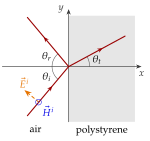
Snell's law gives , the Fresnel formulas for P polarisation give and . Reflectivity and transmissivity are power ratios across the interface, and . The cosines appear because the three beams share one footprint on the interface but have the cross-sections and (Figure 6.4.5), while each beam carries through its own cross-section.
, (, ), and :
Compare below with (switch to S) at , then drag the ray to .
Power per square metre of interface: , and .
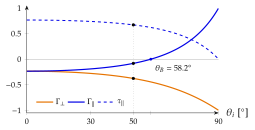
The transmitted beam is wider than the incident one, so its power density is below although it carries of the power. is close to the Brewster angle : the P beam loses only , whereas an S beam would see and lose .