Section 6.4 · Problems · 4 of 6
Problem 6.4.4: Oblique incidence on a perfect conductor
Oblique incidence on a perfect conductor
#A uniform sinusoidal plane wave in air with the following phasor expression for electric intensity
is incident on a perfectly conducting plane at .
- Find the frequency and wavelength of the wave.
- Determine the angle of incidence.
- Find the reflected electric and magnetic fields.
- Find the total field in air and the planes where vanishes.
- Find the surface current density on the plane.
Adapted from: D. K. Cheng, Field and Wave Electromagnetics, 2nd ed., Problem P.8-22.
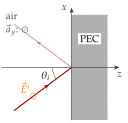
A plane wave varies as with and , and . Here the interface is , so its normal is and is measured from . The plane of incidence is the -plane, and is perpendicular to it: S polarisation, with at a perfect conductor.
Matching :
In the time domain .
, so and .
keeps the -part of the direction and reverses the -part: . for every requires :
Likewise .
Adding the two waves, with and :
In the time domain : a standing wave along and a travelling wave along . on the planes
Along the phase constant is : and .
The normal pointing out of the conductor is , and at only survives:
: there is no normal at a perfect conductor. . The time-average Poynting vector is : power flows only parallel to the wall, and the -part of the field is purely reactive.
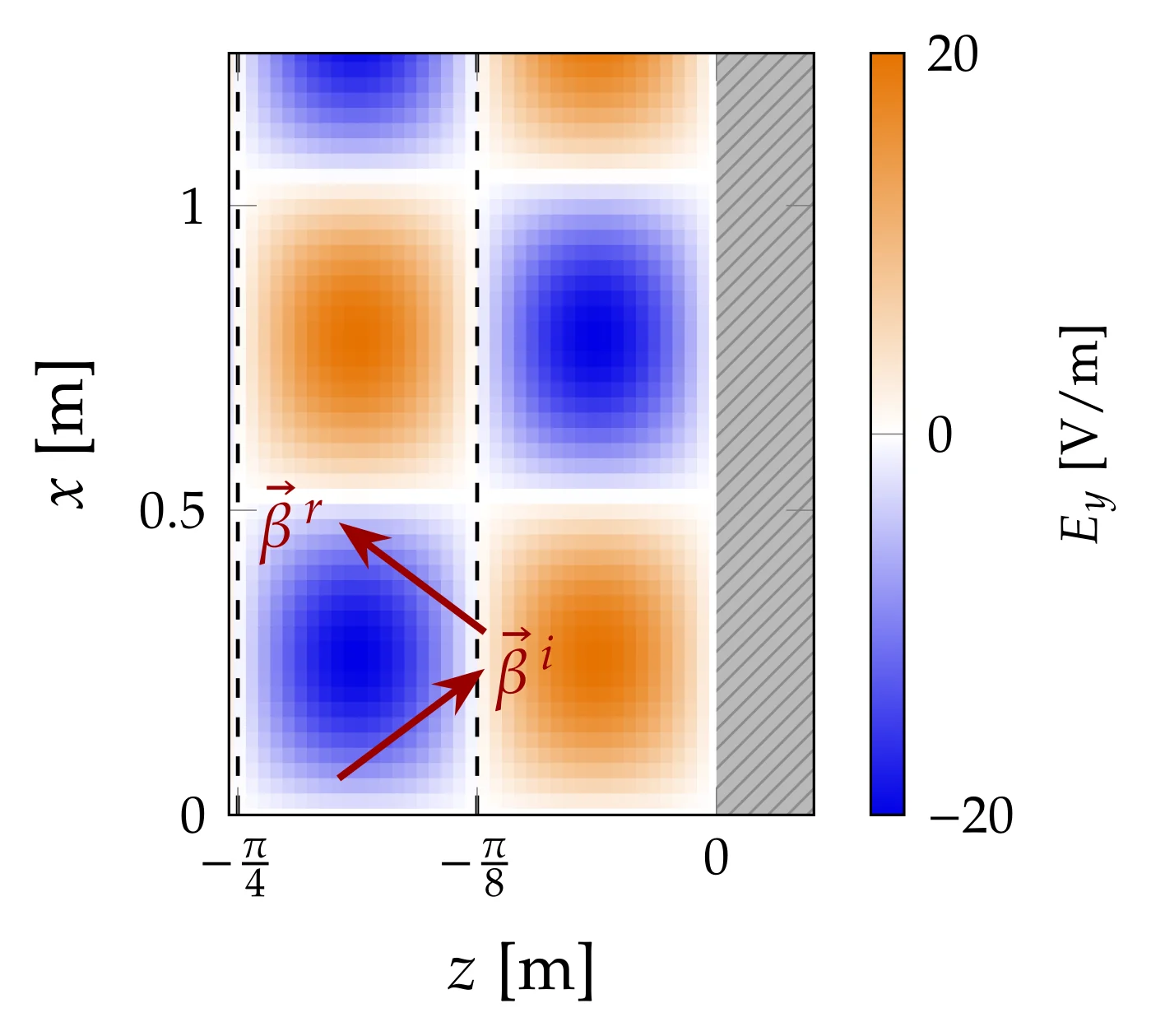
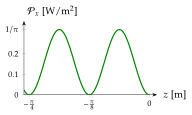
The pattern is a standing wave across the wall () and a travelling wave along it (): the cells slide upwards at . Power flows only along , most strongly halfway between the nodal planes. A second conducting plane at would sit where already, so it would disturb nothing: the field between the two plates is a mode of a parallel-plate waveguide, guided along at the phase velocity . This is the starting point of Section 7.2.