Section 6.4 · Problems · 3 of 6
Problem 6.4.3: Fibre optics
Fibre optics
#An optical fibre is given in the picture below. The refractive indices of the core and the cladding are and , respectively.
- Calculate the critical angle of the total reflection phenomenon.
- Find the largest angle a guided ray can make with the fibre axis.
- Find the acceptance angle and the numerical aperture for light launched from air.
- Over , find the delay between the axial ray and the steepest guided ray.
Source: S. J. Orfanidis, Electromagnetic Waves and Antennas, Example 7.5.5.
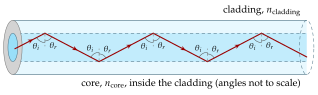
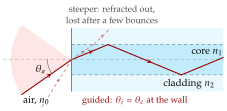
A ray stays in the core if it meets the core-cladding wall beyond the critical angle. The angle is measured from the normal of the wall, the angle of the ray from the fibre axis, so . Snell's law at the end face converts the largest into an angle in air, and a ray at travels the path at the speed .
The ray goes from the denser core into the cladding, so total reflection is possible:
Every ray with is trapped in the core.
: the guided rays are almost parallel to the axis.
At the end face , with for air, and :
The axial ray needs . The steepest guided ray travels , so
and . For a small index step with : .
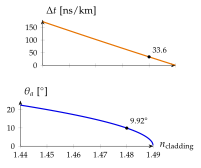
A delay spread of limits this step-index fibre to roughly over a kilometre. Telecommunication fibre uses and a core so thin that only one mode propagates, and graded-index fibre equalises the delays of the rays.