Section 6.4 · Problems · 2 of 6
Problem 6.4.2: Total internal reflection in a prism
Total internal reflection in a prism
#A right-angle glass prism (, nonmagnetic) turns a beam of light of free-space wavelength through : inside the glass the beam meets the hypotenuse face at , with air outside.
- Show that the beam is totally reflected.
- Find and (magnitude and phase).
- Find the attenuation constant of the field in the air just outside the hypotenuse, and the distance in which it falls to .
- Show that no time-average power flows into the air.
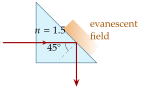
Compare with . Beyond Snell's law gives , and is the imaginary root that makes the field decay into the air, Eq. (6.4.18). With it the Fresnel coefficients still hold. Work with impedances divided by : medium 1 is the glass, , medium 2 the air, .
: the beam is totally reflected.
, , :
, , , and from Eq. (6.4.19)
so the field falls to in . Along the face it varies as with .
S case: and . The normal component of the time-average Poynting vector is
In the P case is in quadrature with , and again .
Numerator and denominator of each are complex conjugates (apart from the sign in ), so . This agrees with : the reflected wave must carry all the incident power. The phases follow from Eq. (6.4.20): .
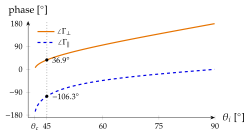
The field in the air is not zero: , so right at the surface, and : power flows along the face inside the evanescent layer but not away from it. Just above the field reaches far into the air ( at ): the reflection is total but not sharp. The phases of and differ, so total reflection turns linear into elliptical polarisation. The Fresnel rhomb uses two such reflections to make circular polarisation, and Exercise 6.4.5 follows the same effect through a Porro prism.