Section 6.4 · Problems · 1 of 6
Problem 6.4.1: Oblique incidence on a dielectric, both polarisations
Oblique incidence on a dielectric, both polarisations
#A uniform plane wave with electric-field amplitude travels in air and is incident at on the plane surface of a lossless nonmagnetic dielectric with .
- Find the angle of refraction .
- For perpendicular (S) polarisation find , and the fractions of the incident power reflected and transmitted.
- Repeat (b) for parallel (P) polarisation.
- The incident wave is linearly polarised at to the plane of incidence. Describe the polarisation of the reflected and transmitted waves and find the fraction of the power reflected.
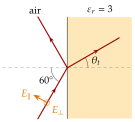
Snell's law first. Then divide the numerator and the denominator of each Fresnel coefficient by , so that only and the two cosines appear. At oblique incidence the transmitted power fraction is the ratio of the normal components of the Poynting vectors, , Eq. (6.4.15). In (d) the S and P parts of the field are treated separately and recombined.
, :
With , and :
is the Brewster angle: , and indeed .
At to the plane of incidence , each carrying half of the incident power. The reflected wave has and : it is linearly polarised perpendicular to the plane of incidence. The reflected fraction is . The transmitted wave has and , both real and in phase: it is linearly polarised at to the plane of incidence.
for each polarisation, and the transmitted fraction in (d), , completes the reflected . The angle forms of Home exercise 6.4.2 give the same numbers: and .
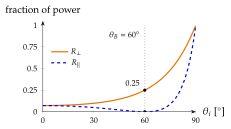
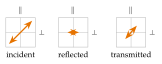
At any incident polarisation leaves the surface as pure S: polarisation by reflection. The transmitted field is tilted towards P ( instead of ) because all of the P power but only of the S power gets through.