Section 6.4 · Further exercises · 5 of 10
Exercise 6.4.5: Polarisation in a Porro prism
About the further exercises of Section 6.4
Ten further exercises in the spirit of Problems 6.4.1–6.4.6 and the home exercises, in two groups each graded from easy to harder: Exercises 6.4.1–6.4.5 on the coefficients, the critical angle and the Brewster angle, Exercises 6.4.6–6.4.10 on applications in radio, fibre optics, microscopy, radomes and metal walls. They use only the equations listed at the head of this subsection and, where stated, the normal-incidence results of Section 6.3.
Polarisation in a Porro prism
#A Porro prism is a right-angle glass prism () used backwards: light enters the hypotenuse face at normal incidence, is totally reflected at by one leg and then by the other, and leaves through the hypotenuse travelling back. Both reflections share the same plane of incidence. The incoming light is linearly polarised at to that plane. (a) Show that the hypotenuse face does not change the polarisation, and find the power lost there. (b) Using Problem 6.4.2, find the phase difference between the P and S components produced by one reflection. (c) Describe the polarisation of the emerging light and find the fraction of its power that passes a polariser crossed with the incident polarisation. (d) What index would make the emerging light circularly polarised?
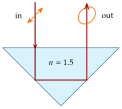
At each reflection the S and P components are multiplied by their own unit-modulus coefficients, and only the difference of their phases changes the polarisation. To chain two reflections, describe every ray with a right-handed triad , , with normal to the common plane of incidence. The reference vector of in Figure 6.4.10 forms a left-handed triad with and (the minus sign of in Eq. (6.4.25)), so in the right-handed description the P coefficient is .
At normal incidence , so both components see the same : entering, leaving, and the ratio is unchanged. Each crossing transmits of the power: , so is lost.
From Problem 6.4.2 at : and . One reflection advances P relative to S by .
Two reflections: , with equal amplitudes . Resolve along (the incident direction) and :
in phase quadrature. The light is elliptically polarised, with its major axis along the incident polarisation and the axial ratio . A crossed polariser passes of the emerging power.
For a general , with , the coefficients give and , and their difference satisfies
Circular output needs , that is : , so and .
For the formula gives , . For : , , . The result was also confirmed by solving the boundary conditions for the full three-dimensional fields of both reflections.
Total reflection is not polarisation-neutral: a Porro prism turns linear light into elliptical light. In a Porro prism the phase shift is the same over the whole beam and only the polarisation suffers. In a roof prism the two halves of the beam are reflected by the two roof faces in opposite order, acquire different phase shifts and then interfere, which blurs the image: roof-prism binoculars therefore carry thin phase-correction coatings. The Fresnel rhomb exploits the same effect on purpose.
cf. Problem 6.4.2