Section 6.4 · Further exercises · 6 of 10
Exercise 6.4.6: Radio waves skimming the ground
About the further exercises of Section 6.4
Ten further exercises in the spirit of Problems 6.4.1–6.4.6 and the home exercises, in two groups each graded from easy to harder: Exercises 6.4.1–6.4.5 on the coefficients, the critical angle and the Brewster angle, Exercises 6.4.6–6.4.10 on applications in radio, fibre optics, microscopy, radomes and metal walls. They use only the equations listed at the head of this subsection and, where stated, the normal-incidence results of Section 6.3.
Radio waves skimming the ground
#A wave is reflected by flat, dry ground, which may be taken as lossless and nonmagnetic with . Radio engineers use the grazing angle . Horizontal polarisation is S and vertical polarisation is P. (a) Find and at , , , and . (b) At which grazing angle is a vertically polarised wave not reflected at all? (c) Show that for both tend to , find first-order approximations, and show that for both polarisations the incident and reflected fields cancel at the ground.
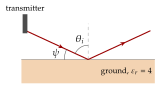
In units of : , , with and . Near grazing is small while stays finite, so the terms with drop out of both Fresnel formulas.
Snell's law and the Fresnel formulas give
For example at : , , and
at the Brewster angle , that is at the grazing angle . There .
With and , to first order in
that is and at , against the exact and . For S, : the horizontal of the reflected wave cancels the incident one at the ground. For P, the reference directions of Figure 6.4.10 give the incident and reflected fields the same tangential reference but opposite normal references, so means that the vertical components, which carry nearly all of at grazing incidence, cancel.
At both formulas give . changes sign at , as it must on passing through the Brewster angle (Figure 6.4.22).
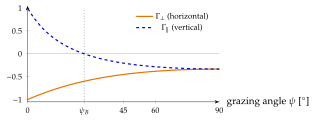
Radio texts often define a vertical reflection coefficient with respect to the vertical field, equal to here, and then both coefficients tend to at grazing incidence. This is the basis of the plane-earth (two-ray) model of a link between two low antennas: the direct and the ground-reflected waves travel almost the same path and nearly cancel, and the received field grows in proportion to the antenna heights. That is why VHF and UHF antennas are put on masts.
cf. Problem 6.4.5