Section 6.4 · Further exercises · 7 of 10
Exercise 6.4.7: Angled fibre connectors
About the further exercises of Section 6.4
Ten further exercises in the spirit of Problems 6.4.1–6.4.6 and the home exercises, in two groups each graded from easy to harder: Exercises 6.4.1–6.4.5 on the coefficients, the critical angle and the Brewster angle, Exercises 6.4.6–6.4.10 on applications in radio, fibre optics, microscopy, radomes and metal walls. They use only the equations listed at the head of this subsection and, where stated, the normal-incidence results of Section 6.3.
Angled fibre connectors
#A single-mode fibre has and at . Light travelling along the axis reaches the end face of an open connector, where the fibre ends in air. (a) Find the numerical aperture and the largest angle that a guided ray makes with the axis inside the core. (b) For a face polished perpendicular to the axis, find the fraction of the power reflected and the return loss in dB. Is the reflected light guided back? (c) For a face polished at (an APC connector) find the angle of incidence, the S and P reflectances, and the angle the reflected ray makes with the axis. Is it guided? (d) Find the direction of the beam leaving the fibre. (e) What is the smallest polish angle for which the reflected ray escapes from the core?
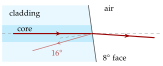
In the ray picture a ray is guided only if its angle to the axis is below . Tilting the face by makes the axial ray meet it at . The reflected ray then makes with the axis. Medium 1 is the core glass, , medium 2 the air.
. Inside the core , .
, a return loss of . The reflected ray runs back along the axis and is guided straight back to the laser.
, , (far below ). In units of , , , , :
so and , hardly different from normal incidence. But the reflected ray makes with the axis: it is not guided and leaks out of the core into the cladding.
The transmitted ray leaves at to the face normal, that is from the fibre axis.
: .
: .
The angled face does not reflect less, it sends the reflection where the fibre cannot carry it. Back-reflections destabilise lasers and add noise in analogue links (cable television over fibre), so such links use angled connectors, polished at to leave a margin over the of the ray picture because the guided mode has a spread of angles. Commercial APC connectors specify return losses of or more. Mating connectors are angled the same way so that the beam crosses the joint undeviated.
cf. Problem 6.4.3